
The Last Block Printers of Kutch — The Living Story of Ajrakh
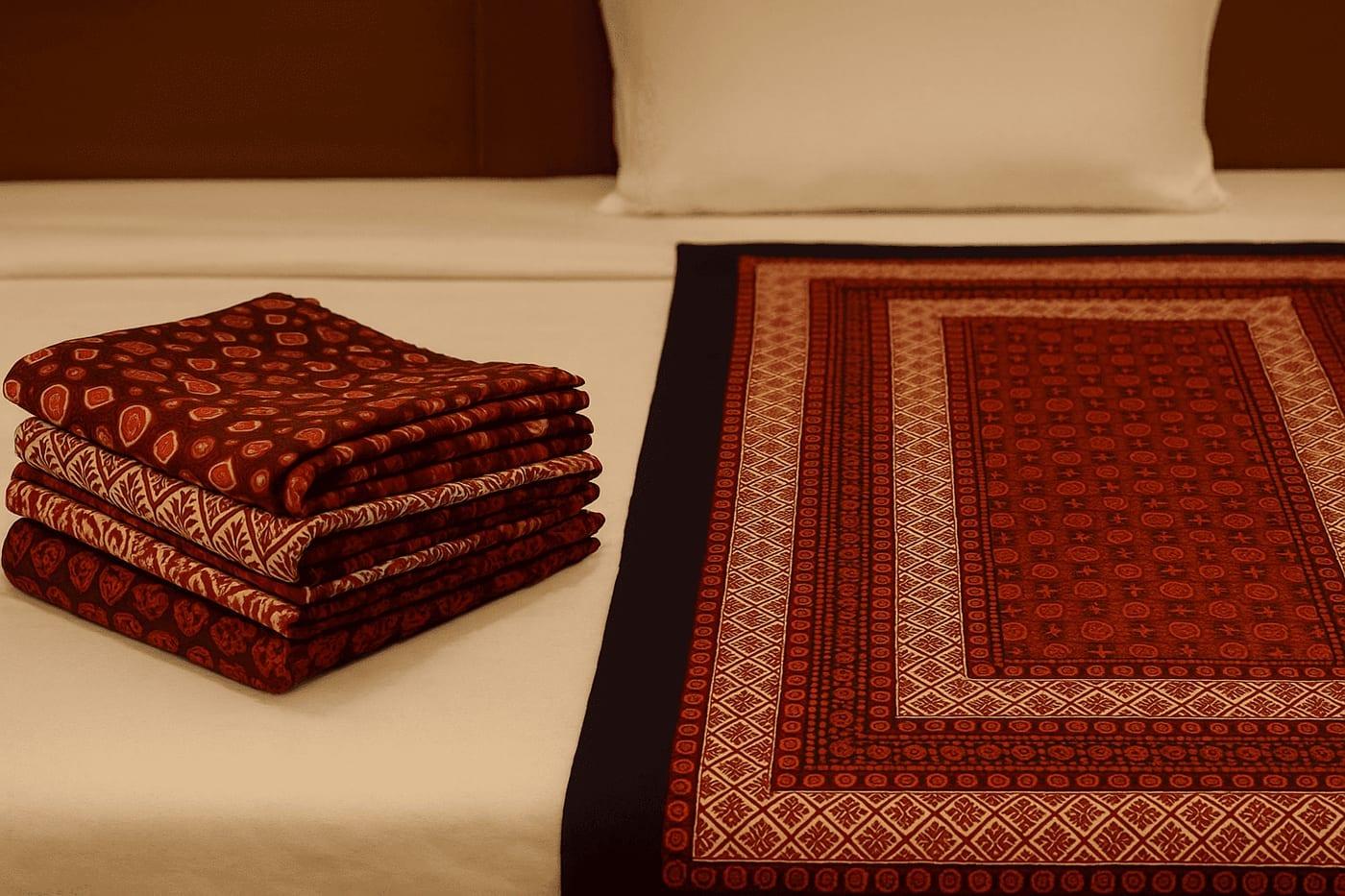
If you visit Ajrakhpur, a small village outside Bhuj in Kutch, in the early morning, you'll find men working at long wooden tables stacked with bolts of cotton. Each table has a row of carved teak blocks resting at the edge. The blocks themselves look like archaeological artefacts — geometric patterns cut by hand into seasoned wood, some over a century old, passed down from father to son. The men are doing what their families have done for fourteen generations: hand-printing Ajrakh.
Ajrakh is one of the oldest known textile traditions in the world. Block-printed cotton fragments matching its motifs and dyes have been recovered from Indus Valley archaeological sites — making the craft, by some counts, more than 4,000 years old. It survived the Mughals, who used it for nobility's garments. It survived British colonialism, which collapsed most indigenous Indian textile industries. It survived the 2001 Kutch earthquake, which flattened entire artisan villages. Today, it is being kept alive by about three hundred families in Kutch and across the border in Sindh, Pakistan. They are, in a real and unhyperbolic sense, the last block printers.
This is the story of how Ajrakh is made — by hand, in fourteen stages, over two to three weeks — and why a piece of cloth you can hold in your fingers carries that much history in it.
What Ajrakh Means
The word "Ajrakh" itself is a small mystery. The most cited etymology traces it to the Arabic "azrak," meaning blue — a nod to the dominance of indigo in the palette. Others connect it to the Sindhi phrase "aaj rakh," meaning "keep it today," a story of patient ritual cloth-making told and retold across generations. Either way, the name and the craft are inseparable: there is no Ajrakh without the deep, layered indigo blue. Add to it madder root for red, iron salts for black, pomegranate skin for yellow, and a base of cotton readied through alkaline baths — and you have the chromatic vocabulary of Ajrakh.
The motifs themselves are a vocabulary too. Cintamani — three dots in a triangle, a symbol of fertility and wealth. Jaalis — geometric lattices borrowed from Mughal architecture. Stars, eight-petalled florals, stylised camels, peacocks. Each design tells you the artisan family, the region, sometimes the decade in which the block was carved. A trained eye can read an Ajrakh shawl the way a sommelier reads a vineyard.
Why Kutch?
Kutch sits at the mouth of the Indus. For four millennia it has been a crossroads — Sindhi traders, Gujarati shipbuilders, nomadic Rabari herders, Jat weavers, Muslim block-printers fleeing partition. Ajrakh's home is the Khatri community, a Muslim caste that migrated to Kutch from Sindh in the late 1500s. They settled in villages around Bhuj — Dhamadka, then later Ajrakhpur — for a single practical reason: the water.
Authentic Ajrakh depends on specific water chemistry. The dyes — particularly indigo — react with iron and minerals in groundwater. Sindhi water carried the right balance. When the original Khatri settlers found similar water in Dhamadka, the craft moved with them. When the 2001 earthquake destroyed Dhamadka's water sources, they relocated again and built Ajrakhpur — a planned village named for the craft itself. The water still has to be right.
This is why Ajrakh cannot just be made anywhere. The cloth, the climate, the water, the hands — all of it co-evolved over centuries. Move one ingredient and the result isn't Ajrakh, it's an approximation.
The Fourteen Stages
When we say a piece of Ajrakh takes two to three weeks to make, we don't mean two to three weeks of intermittent attention. We mean fourteen separate stages of work, each one requiring the cloth to dry, to be re-bathed, to be printed, to be washed again, to be dried again. Skip a stage and the piece fails. Rush one and the colours bleed. Here's how it actually works.
Stage 1: Saaj — The First Wash
Plain mill-woven cotton arrives at the artisan's workshop. It is rough, sized with starch, and unable to accept dye. Saaj is a long soak in a solution of camel dung, soda ash, and castor oil. The dung softens the fibres; the alkali strips the starch; the oil prepares the surface to take pigment. After 12 hours of soaking, the cloth is beaten on rocks at the village water tank and dried in the sun.
Stage 2: Harda — Yellow Pre-Bath
The softened cloth is dipped in a yellow bath of harda (myrobalan), a fruit-derived mordant. This sets the cotton up to accept later natural dyes — without harda, indigo and madder simply wash out. The cloth dries to a pale yellow.
Stage 3: Kat — Outline Printing
The yellow-toned cotton is laid flat. The block-printer dips a carved teak block into a black resist paste made of iron filings, jaggery, lime, and tamarind seed gum. The paste prints the outline of the design — the resist that will later refuse to absorb other dyes.
Watching a master printer work is to watch a metronome. The block lifts, drops, lifts, drops — perfectly aligned every time. There are no measuring tools, no guides. The eye and the hand have practised this thousands of times. A small misalignment on stage 3 will compound into chaos by stage 11. The best printers we know can produce a finished metre with less than two millimetres of total drift across hundreds of block impressions.
Stage 4: Kareekat — Red Mordant Print
A second printing pass adds alum mortant paste, mixed with red clay so the printer can see what they've already covered. Alum is the mordant for madder red. Wherever alum sits, madder will later dye the cloth red.
Stage 5: Gachh — White Resist Print
A third printing pass, this one with a paste of lime, gum and clay. This is the white resist — the areas it covers will remain white through all subsequent dye baths. It is the most patient stage; the resist must be applied evenly, or the white areas will show shadow.
Stage 6: Drying
The triple-printed cloth is dried slowly in the shade for two to three days. Direct sun would crack the resist. Wind would warp the cloth. Patience is what the craft demands more than anything else.
Stage 7: Madder Bath
Now the cloth goes into a deep red madder bath, heated over wood fires. Madder root — soaked, ground, simmered — produces a deep terra-cotta red. The alum-printed areas come out brick red. The black-resist areas stay black. The lime-resist areas stay white. The unprinted background takes a pale madder tint.
Stage 8: River Wash
The dyed cloth is taken to the water tank — historically the Indus, now a village-maintained tank in Ajrakhpur — and beaten on flat stones to wash out excess dye. This is the stage that requires the right water chemistry. Wrong water, wrong wash, wrong colour stability.
Stage 9: Indigo Bath
The most iconic stage. The cloth is dipped repeatedly into a fermented indigo vat — natural indigo dye is greenish in the vat and oxidises to blue when lifted into air. Each dip deepens the blue. A printer might dip a single Ajrakh five to seven times to achieve the deep indigo blue that defines the cloth.
The indigo vat is a living thing. The fermentation has to be tended. Wrong temperature, wrong pH, wrong fruit-and-jaggery balance and the whole vat dies. Some master printers can identify a healthy vat by smell within five seconds of walking into the workshop.
Stages 10–13: Detail Layers
Subsequent stages add detail: a second resist layer, a second madder bath, sometimes a pomegranate or turmeric bath for yellow accents. Each adds depth and visual richness. By stage 13, a piece of Ajrakh has been printed five times, dyed three times, washed five times, and dried six times.
Stage 14: Final Setting
The finished piece is washed one last time with neem leaves — which act as a natural fixative — and dried in the shade. Only then is it ready to be folded, packaged, and sent out. Two to three weeks of work for a single piece of cloth.
The Economics — and Why This Craft Almost Died
Two to three weeks of artisan labour, plus expensive natural dyes, plus the cost of running a wood-fired workshop, plus the cost of land in a Kutch artisan village. Even a modest Ajrakh shawl costs ₹2,000 to ₹5,000 to produce ethically. Machine-printed approximations cost ₹50–₹100 to produce in a Surat textile factory.
For most of the 20th century, mass-produced fabric pushed Ajrakh to the edge. By the 1990s, fewer than fifty families in Kutch still practised the craft commercially. The 2001 earthquake nearly finished the job — workshops destroyed, dye-vats lost, water sources contaminated.
What saved Ajrakh was a combination of three things: state-level intervention by the Gujarat government, design-school revival programmes by NIFT and NID, and a new generation of urban Indian buyers willing to pay artisan prices for heritage textiles. By 2010, the craft had stabilised. By 2020, third-generation Khatri printers were experimenting with new motifs and new colour combinations — Ajrakh evolving, not just preserved.
Today, perhaps three hundred families in Kutch and Sindh still print Ajrakh full-time. They're surrounded by competition from machine-printed lookalikes, often sold dishonestly as the real thing. The biggest threat to the craft is no longer scarcity of buyers — it's the difficulty of distinguishing the genuine from the fake.
How to Tell Real Ajrakh from Imitation
Our → Complete Cotton Shawl Buying Guide covers this in detail, but here are the three tests that matter most:
- Look at the reverse side. Real Ajrakh shows the print equally crisp on both sides — natural dyes penetrate fully through the cotton. Machine-printed imitations only colour the front face.
- Inspect for irregularities. Hand-block printing produces small alignment drifts and ink-density variations between block impressions. Mechanically perfect prints are a sign of mass production.
- Smell the cloth. Real Ajrakh has a faint warm scent from natural dyes (something between earth and old books). Synthetic-dyed imitations have a sharp chemical smell, especially when new.
Why Buying Real Matters
When you buy an authentic Ajrakh shawl, the math is roughly this: ₹2,000–₹3,000 of the price goes to the artisan family that printed it. That's two to three weeks of skilled work for a family that still trains the next generation in the craft. Buy a machine-printed approximation and you've supported a Surat textile factory; the ₹500 you saved came at the cost of a tradition.
This isn't a guilt-trip argument. It's a practical one. Ajrakh exists today only because there's a market for it. Every authentic piece sold sustains the craft. Every fake piece — sold to buyers who don't know the difference — chips away at it. The 300 artisan families left in Kutch and Sindh are doing extraordinary work; choosing to buy from them keeps that work viable.
Our Promise on Ajrakh
Every Ajrakh shawl we sell at KaiBee is sourced directly from artisan families in Kutch. We pay the artisan price, not the wholesaler price. We name the village where each piece was printed. And we'll show you the reverse side of any shawl before you buy — because the back of an Ajrakh is where its honesty lives.
₹399
₹799
50% OFF
Visit Kutch if You Can
If you're ever in Gujarat, take a day to visit Ajrakhpur. The artisan families welcome visitors — many run small workshops where you can watch the printing in real-time. Bhuj is the nearest big town; from there, Ajrakhpur is a 45-minute drive. November to February is the best season — Kutch is mild, the workshops are active, and Rann Utsav makes the region easy to visit.
You'll come back with a deeper appreciation for what those wooden blocks have made for forty centuries. And probably a shawl or two.
If you found this piece valuable, please share it. The future of Ajrakh depends on more people knowing the difference between the real and the imitation — and being willing to pay for the real.